
Vortex excitations and Josephson supercurrents in quantum bosonic mixtures

Mixtures of ultracold quantum gases offer an exceptional playground to study macroscopic quantum phenomena — from quantized vortices, the signature of superfluidity, and the phase separation to Josephson supercurrents. Our research explores the dynamics, the stability properties of massive quantum vortices, and the intervortex supercurrents they sustain. We are interested in how these systems give rise to emergent behaviors such as a chaotic dynamics and scattering effects, in the intriguing role of dipolar interactions and in the study of the vortex phenomenology in fluids of light and fermionic systems. These studies and their extension to lattice models pave the way toward innovative applications in the growing field of atomtronics.
Quantum simulation with ultracold atoms and molecules
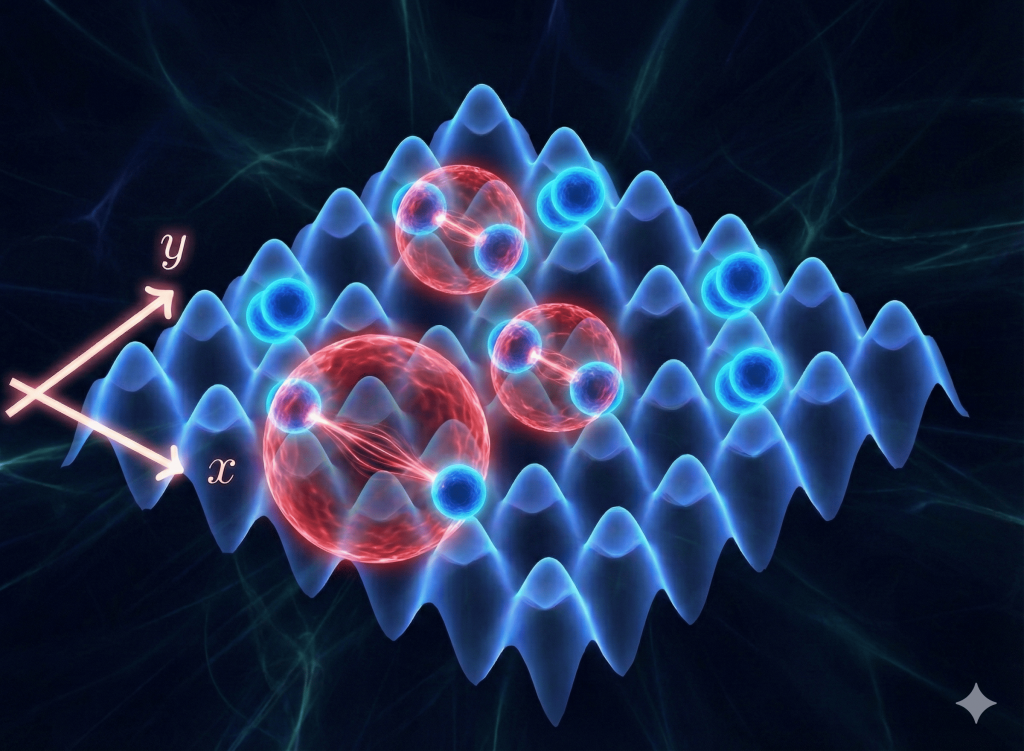
Our research focuses on the quantum simulation of strongly correlated and exotic phases of matter. We investigate topological phases, lattice gauge theories, and frustrated many-body systems using synthetic quantum materials made of ultracold atoms and molecules. By combining advanced quantum algorithms with the theoretical design of atomic quantum simulators, we aim to uncover emergent phenomena that are difficult or impossible to access with classical approaches. Our work bridges theory and experiment, providing insights into novel quantum states and offering pathways for their realization in state-of-the-art quantum platforms.
Quantum algorithms

Our research activity focuses on the development and application of quantum algorithms for the study of complex quantum many-body systems. In particular, we employ path integral quantum Monte Carlo methods to investigate the properties of two- and three-dimensional strongly interacting bosonic quantum systems. Moreover, we develop and apply tensor network methods to study the equilibrium and nonequilibrium properties of low-dimensional strongly interacting bosonic and fermionic quantum matter. By combining these complementary approaches, we aim to advance the theoretical understanding of quantum matter and to devise innovative computational strategies for problems that remain challenging for conventional classical methods.